Announcing Dart 3.13
Bringing conciseness and simplicity to Dart codebases, tooling, and platforms.


We're thrilled to announce Dart 3.13!
In this release, we're celebrating a theme that every developer loves:
clean and lightweight code.
Dart 3.13 brings this focus to every layer of the developer experience.
On the language front, primary constructors eliminate repetitive boilerplate
so you can define classes in a single line of code.
In developer tooling, refinements to dart format keep your code neat
according to Effective Dart style rules,
while dart pub introduces new workspace commands to keep monorepos tidy.
On pub.dev, richer documentation features like <callout-box> tags and
{@example} directives make package docs clearer to read.
Under the hood, native library tree-shaking (@RecordUse) and
WebAssembly deferred loading help keep your
compiled application binaries as compact as possible.
So update Dart or
run flutter upgrade
and follow along as we explore what's new in Dart 3.13!
Language updates
#Primary constructors
#Following an experimental preview in Dart 3.12, primary constructors are now officially stable in Dart 3.13!
Primary constructors represent a major step forward for class conciseness.
We've heard from developers that repeating field names and types
across class bodies and parameter lists can feel tedious.
Primary constructors remove that repetition, letting you define, for example,
a Point class with two fields and a constructor in a single line of code:
class Point(final int x, final int y);
This feature also includes
concise syntax for constructors
using the new or factory keywords,
allowing empty declaration bodies to end with a ;.
To help you adopt primary constructors and maintain a consistent style across your codebase, we've introduced several new lints with automated fixes:
-
empty_container_bodies: Encourages brevity by using;rather than{}in class-like declarations. -
initialize_in_field_declaration: Encourages clarity by moving field initialization from a primary constructor to the field declaration. -
unnecessary_const_in_enum_constructor: Encourages brevity by removingconstfrom enum constructors. -
unnecessary_primary_constructor_body: Encourages brevity by removing unneeded primary constructor bodies. -
unnecessary_type_name_in_constructor: Encourages brevity by replacing the type name withnewin constructor declarations. -
use_declaring_parameters: Encourages brevity by using declaring parameters where possible.
Along with these lints, we've also added new IDE refactorings to automate your code migration:
- Convert to primary constructor: Converts an eligible in-body constructor to a primary constructor.
- Convert to in-body constructor: Converts a primary constructor to an in-body constructor.
- Convert to declaring parameter: Converts a non-declaring parameter in a primary constructor to a declaring parameter.
- Move initialization to the field declaration: Moves field initialization from the constructor initializer list to the field declaration.
Learn more: Primary constructors documentation
Web platform updates
#WebAssembly deferred loading preview
#
We've been hard at work expanding WebAssembly capabilities for Dart on the web.
In Dart 3.13, we're excited to share an early preview of
deferred loading support when compiling with dart2wasm.
You can enable it today using the experimental compiler flag:
dart compile wasm -O2 --enable-deferred-loading
In large applications using deferred loading, dart2wasm delivers significant
initial page load (IPL) time improvements compared to dart2js,
benefiting both Flutter web apps and DOM-based web applications.
As a reminder, the legacy web libraries like dart:html and package:js
aren't supported in dart2wasm and were deprecated in Dart 3.7
(and will stop working in dart2js in the future).
Many packages are already migrated,
so upgrading your package dependencies often resolves issues automatically.
However, if your code directly uses these legacy libraries,
check out our migration guides to adopt the supported
dart:js_interop and
package:web
libraries today.
Learn more: WebAssembly documentation
Core engine and runtime updates
#Engineering highlights
#Alongside our web platform progress, our team is constantly improving the foundation of Dart. Here are a few highlights of what we've worked on behind the scenes over the past three months:
- Type promotion soundness fix: Fixed a rare unsoundness issue with type promotion involving nested functions.
- Common front-end refactoring: Refactored internal common front-end components to enable greater code sharing with the Dart analyzer.
- DDC module system unification: Continued removing legacy module systems from the Dart Development Compiler (DDC) across tools to establish a single, unified module system.
- Native runtime memory safety: Enhanced native runtime memory safety by introducing a memory cage around the Dart heap.
- Dynamic module linking: Initiated experiments with dynamic modules to enable dynamic code linking, paving the way for improved development workflows like fast prototype sharing within a team.
Tools updates
#Dart formatter
#
Keeping codebases tidy and easy to read is a top priority for dart format.
In Dart 3.13, we've introduced a handful of style tweaks
to make formatted code even cleaner.
While most changes are minor, a few key updates will make your
everyday code noticeably easier to read:
-
Method call misformatting fix: We fixed a bug where an optimization would sometimes erroneously kick in and misformat code. It mostly pops up around method calls containing large collection literals:
dart// Before: await MethodChannelContainer() .onMethodChannelInvoke('reportCrash', <String, Object?>{ 'time': nowTime, 'errorValue': errorName, 'reason': reason, 'stacktrace': stacktrace, }); // After: await MethodChannelContainer().onMethodChannelInvoke( 'reportCrash', <String, Object?>{ 'time': nowTime, 'errorValue': errorName, 'reason': reason, 'stacktrace': stacktrace, }, ); -
Method chain split heuristics: We changed the heuristics around whether the formatter decides to split a method call chain at the
.or inside one of the argument lists. If the target of the method chain is a collection literal or function call with a single element or argument, it now prefers to split the call chain instead of the target:dart// Before, split the target: function( argument, ).method().another(); // After, split the chain: function(argument) .method() .another(); -
Import section separation: The formatter now inserts a blank line between different "sections" within a series of imports. The formatter doesn't sort the imports, but it does now separate them, according to the rules in Effective Dart:
dart// Before: import 'dart:io'; import 'dart:math'; import 'package:args/args.dart'; import 'package:test/test.dart'; import 'my_library.dart'; // After: import 'dart:io'; import 'dart:math'; import 'package:args/args.dart'; import 'package:test/test.dart'; import 'my_library.dart';
There are some other style tweaks described in the dart_style
changelog,
but those are the most visible ones.
We know that formatting changes can cause annoying churn,
so we try to be conservative when changing the style.
At the same time, a style improvement can make code easier to read,
which is a valuable benefit in an era when we're all
reviewing more code than ever thanks to generative AI.
Aside from the optimization bug fix, these style changes are
language-versioned.
You'll only see them after you upgrade your code to Dart 3.13.
Learn more: Dart formatter documentation
Pub updates
#Package documentation updates
#
Clear and well-structured package documentation is
essential for a healthy ecosystem.
To help package authors create cleaner, more maintainable docs, pub.dev now
supports <callout-box> tags and {@example} directives end-to-end.
You can extract code snippets directly from example files
into your API documentation while hiding unnecessary boilerplate.
For example, define a snippet region in example/foo.dart:
// example/foo.dart
void main() {
  // #region abc
  // Included in documentation
  foo();
  assert(false); // #hide
  // #endregion
}
Then reference that region in your Dart doc comments:
/// This is a great function.
///
/// Example usage:
/// {@example /example/foo.dart#abc}
void foo() {}
pub.dev renders the specified code region directly in the generated documentation.
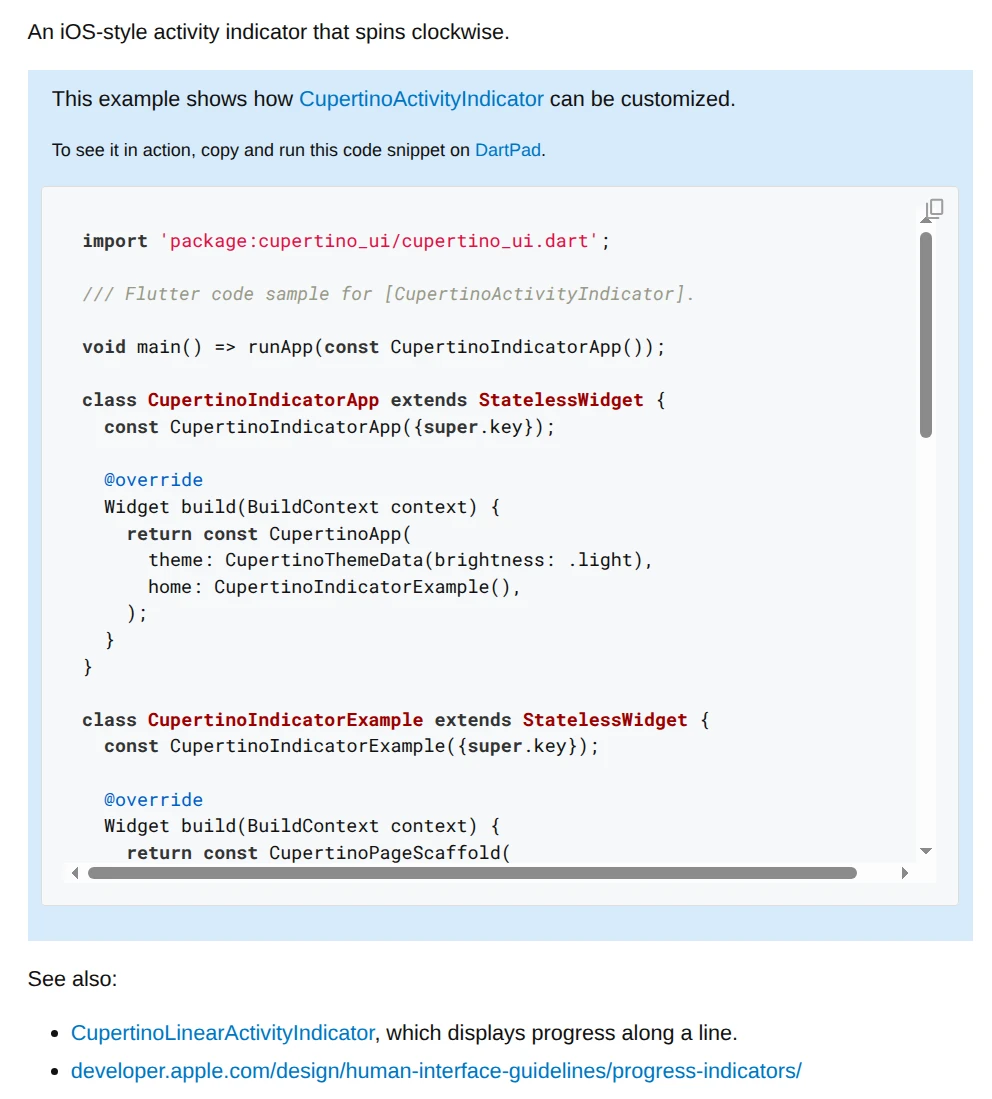
<callout-box> with a blue border alongside an embedded
{@example} code block.
Behind the scenes, pub.dev also deployed a two-level hash index for dartdoc file lookups. This update drastically speeds up documentation rendering for large packages containing 100k+ generated files.

Learn more: CupertinoActivityIndicator class documentation
Native interop updates
#Tree-shaking native libraries with @RecordUse and package:record_use
#
Our commitment to efficiency extends all the way down to
your compiled application binaries.
When building Dart and Flutter apps that interoperate with
native C, C++, or Rust code using dart:ffi and Code Assets,
the Dart compiler has always tree-shaken unused Dart wrapper functions.
However, the underlying native binaries traditionally remained bundled in full.
With @RecordUse (in package:meta) and package:record_use,
Dart and Flutter can now tree-shake native libraries alongside your Dart code.
This ensures your final application bundle contains only
the native code your app actually invokes.
How it works
#-
Annotate native FFI bindings with
@RecordUse(): Mark your native FFI bindings (such as those generated byffigen) with the@RecordUse()annotation:dartimport 'dart:ffi'; import 'package:meta/meta.dart'; @RecordUse() @Native<Int32 Function(Int32, Int32)>() external int sqlite3_open( Pointer<Utf8> filename, Pointer<Pointer<sqlite3>> ppDb, ); @RecordUse() @Native<Int32 Function(Pointer<sqlite3>)>() external int sqlite3_close(Pointer<sqlite3> db); -
Track reachable calls during compilation: During whole-program compilation and tree-shaking in Dart AOT builds, the compiler tracks which bindings annotated with
@RecordUse()are reachable in executable code. Calls that reside in unused Dart code that gets tree-shaken away are excluded automatically. -
Prune unused native symbols in your link hook: In your package's link hook (
hook/link.dart), retrieveinput.recordedUses. Usingpackage:record_use, query recorded calls and instruct your native toolchain (such aspackage:native_toolchain_cor a Rust build script) to keep only the symbols that Dart actually calls:dartimport 'package:hooks/hooks.dart'; import 'package:native_toolchain_c/native_toolchain_c.dart'; import 'package:record_use/record_use.dart'; import 'package:my_package/src/c_library.dart'; import 'package:my_package/src/record_use_mapping.dart'; void main(List<String> arguments) async { await link(arguments, (input, output) async { // Extract symbols for functions called in reachable Dart code: final symbolsToKeep = input.recordedUses?.calls.keys .cast<Method>() .map((method) => recordUseMapping[method.name]!); await cLibrary.link( input: input, output: output, linkerOptions: LinkerOptions.treeshake( symbolsToKeep: symbolsToKeep, ), ); }); }
Why this matters
#- Dramatically smaller binaries: Heavy native dependencies like SQLite, cryptography, image decoders, or audio engines expose hundreds of functions. During release builds, the linker strips away unreferenced native code, dead object files, and unused exports.
- Complete omission of unused native libraries: If your application never invokes a package's native bindings, the link hook drops the native binary entirely from the final application bundle.
-
Seamless tooling integration:
Tools like
ffigenautomatically annotate generated bindings, whilepackage:native_toolchain_cintegrates directly with link hooks for end-to-end native tree-shaking.
Learn more: Native link hooks documentation and Record use documentation
Wrap up
#Dart 3.13 brings our vision for a simpler, cleaner developer experience to life. By connecting expressive language features like primary constructors with smarter tooling, richer pub.dev docs, and compact native tree-shaking, this release helps you focus on what matters most: building great apps.
Everything in this release is informed by your real-world insights, bug reports, and package contributions. The Dart ecosystem thrives because of your active participation, and we're deeply grateful for your partnership in shaping where the language goes next.
We can't wait to see what you create with Dart 3.13!
Take a moment to update Dart
or run flutter upgrade
today,
and join the conversation on
our GitHub issue tracker.
Thank you for being such a passionate community and
building the future of Dart with us!
Learn more: Dart SDK changelog