# Understanding null safety
> A deep dive into Dart language and library changes related to null safety.
_Written by Bob Nystrom
July 2020_
Null safety is the largest change we've made to Dart since we replaced the
original unsound optional type system with [a sound static type system][strong]
in Dart 2.0. When Dart first launched, compile-time null safety was a rare
feature needing a long introduction. Today, Kotlin, Swift, Rust, and other
languages all have their own answers to what has become a very [familiar
problem.][billion] Here is an example:
[strong]: /language/type-system
[billion]: https://www.infoq.com/presentations/Null-References-The-Billion-Dollar-Mistake-Tony-Hoare/
```dart
// Without null safety:
bool isEmpty(String string) => string.length == 0;
void main() {
isEmpty(null);
}
```
If you run this Dart program without null safety, it throws a
`NoSuchMethodError` exception on the call to `.length`. The `null` value is an
instance of the `Null` class, and `Null` has no "length" getter. Runtime
failures suck. This is especially true in a language like Dart that is designed
to run on an end-user's device. If a server application fails, you can often
restart it before anyone notices. But when a Flutter app crashes on a user's
phone, they are not happy. When your users aren't happy, you aren't happy.
Developers like statically-typed languages like Dart because they enable the
type checker to find mistakes in code at compile time, usually right in the IDE.
The sooner you find a bug, the sooner you can fix it. When language designers
talk about "fixing null reference errors", they mean enriching the static type
checker so that the language can detect mistakes like the above attempt to call
`.length` on a value that might be `null`.
There is no one true solution to this problem. Rust and Kotlin both have their
own approach that makes sense in the context of those languages. This doc walks
through all the details of our answer for Dart. It includes changes to the
static type system and a suite of other modifications and new language features
to let you not only write null-safe code but hopefully to *enjoy* doing so.
This document is long. If you want something shorter that covers just what you
need to know to get up and running, start with the [overview][]. When you are
ready for a deeper understanding and have the time, come back here so you can
understand *how* the language handles `null`, *why* we designed it that way, and
how to write idiomatic, modern, null-safe Dart. (Spoiler alert: it ends up
surprisingly close to how you write Dart today.)
[overview]: /null-safety
The various ways a language can tackle null reference errors each have their
pros and cons. These principles guided the choices we made:
* **Code should be safe by default.** If you write new Dart code and don't use
any explicitly unsafe features, it never throws a null reference error at
runtime. All possible null reference errors are caught statically. If you
want to defer some of that checking to runtime to get greater flexibility,
you can, but you have to choose that by using some feature that is textually
visible in the code.
In other words, we aren't giving you a life jacket and leaving it up to you
to remember to put it on every time you go out on the water. Instead, we
give you a boat that doesn't sink. You stay dry unless you jump overboard.
* **Null-safe code should be easy to write.** Most existing Dart code is
dynamically correct and does not throw null reference errors. You like your
Dart program the way it looks now, and we want you to be able to keep
writing code that way. Safety shouldn't require sacrificing usability,
paying penance to the type checker, or having to significantly change the
way you think.
* **The resulting null-safe code should be fully sound.** "Soundness" in the
context of static checking means different things to different people. For
us, in the context of null safety, that means that if an expression has a
static type that does not permit `null`, then no possible execution of that
expression can ever evaluate to `null`. The language provides this guarantee
mostly through static checks, but there can be some runtime checks involved
too. (Though, note the first principle: any place where those runtime checks
happen will be your choice.)
Soundness is important for user confidence. A boat that *mostly* stays
afloat is not one you're enthused to brave the open seas on. But it's also
important for our intrepid compiler hackers. When the language makes hard
guarantees about semantic properties of a program, it means that the
compiler can perform optimizations that assume those properties are true.
When it comes to `null`, it means we can generate smaller code that
eliminates unneeded `null` checks, and faster code that doesn't need to
verify a receiver is non-`null` before calling methods on it.
One caveat: We only guarantee soundness in Dart programs that are fully null
safe. Dart supports programs that contain a mixture of newer null-safe code
and older legacy code. In these mixed-version programs, null reference errors
may still occur. In a mixed-version program, you get all of the *static* safety
benefits in the portions that are null safe, but you don't get full runtime
soundness until the entire application is null safe.
Note that *eliminating* `null` is not a goal. There's nothing wrong with `null`.
On the contrary, it's really useful to be able to represent the *absence* of a
value. Building support for a special "absent" value directly into the language
makes working with absence flexible and usable. It underpins optional
parameters, the handy `?.` null-aware operator, and default initialization. It
is not `null` that is bad, it is having `null` go *where you don't expect it*
that causes problems.
Thus with null safety, our goal is to give you *control* and *insight* into
where `null` can flow through your program and certainty that it can't flow
somewhere that would cause a crash.
## Nullability in the type system
Null safety begins in the static type system because everything else rests upon
that. Your Dart program has a whole universe of types in it: primitive types
like `int` and `String`, collection types like `List`, and all of the classes
and types you and the packages you use define. Before null safety, the static
type system allowed the value `null` to flow into expressions of any of those
types.
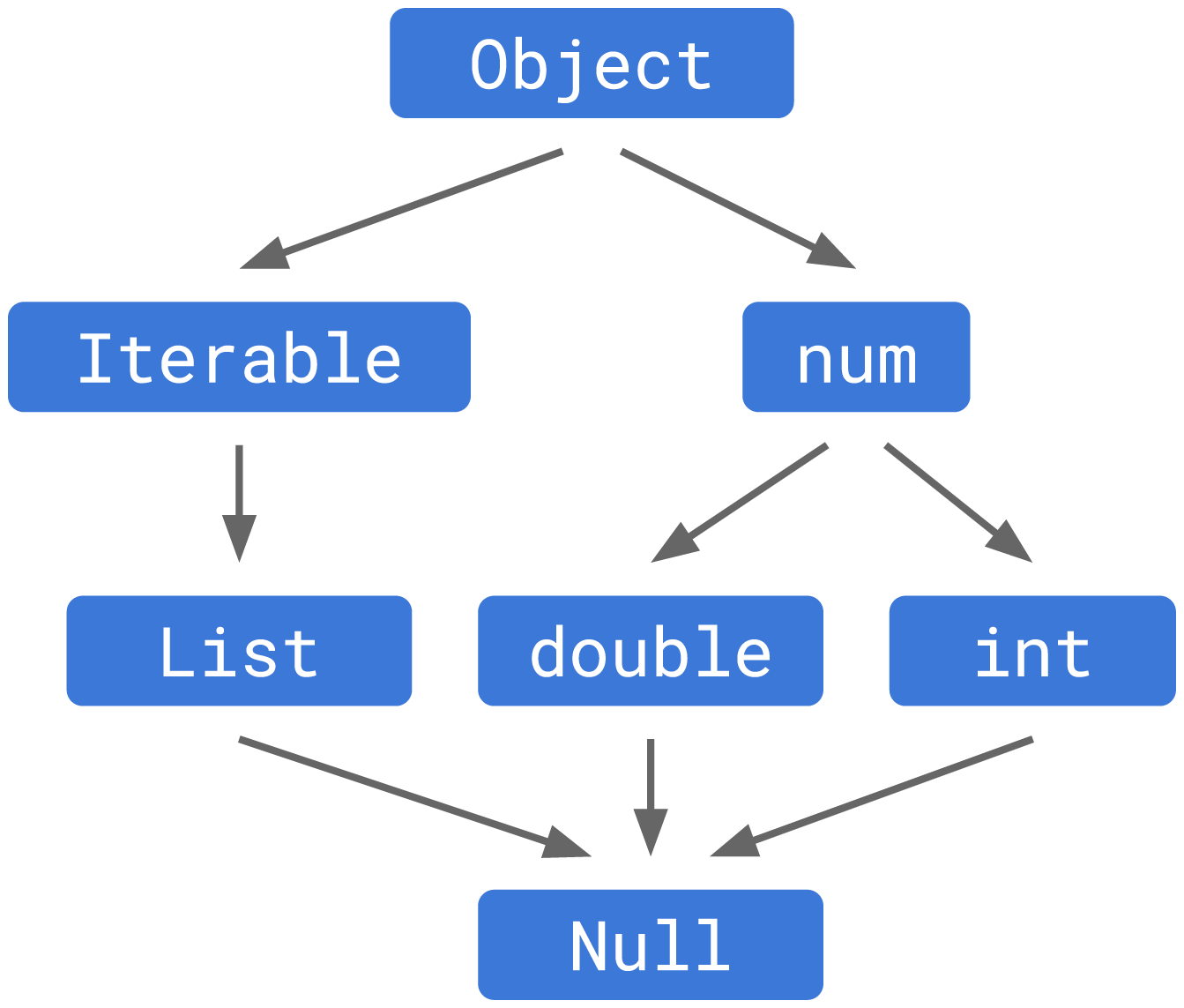
In type theory lingo, the `Null` type was treated as a subtype of all types:
The set of operations—getters, setters, methods, and
operators—allowed on some expressions are defined by its type. If the type
is `List`, you can call `.add()` or `[]` on it. If it's `int`, you can call `+`.
But the `null` value doesn't define any of those methods. Allowing `null` to
flow into an expression of some other type means any of those operations can
fail. This is really the crux of null reference errors—every failure comes
from trying to look up a method or property on `null` that it doesn't have.
### Non-nullable and nullable types
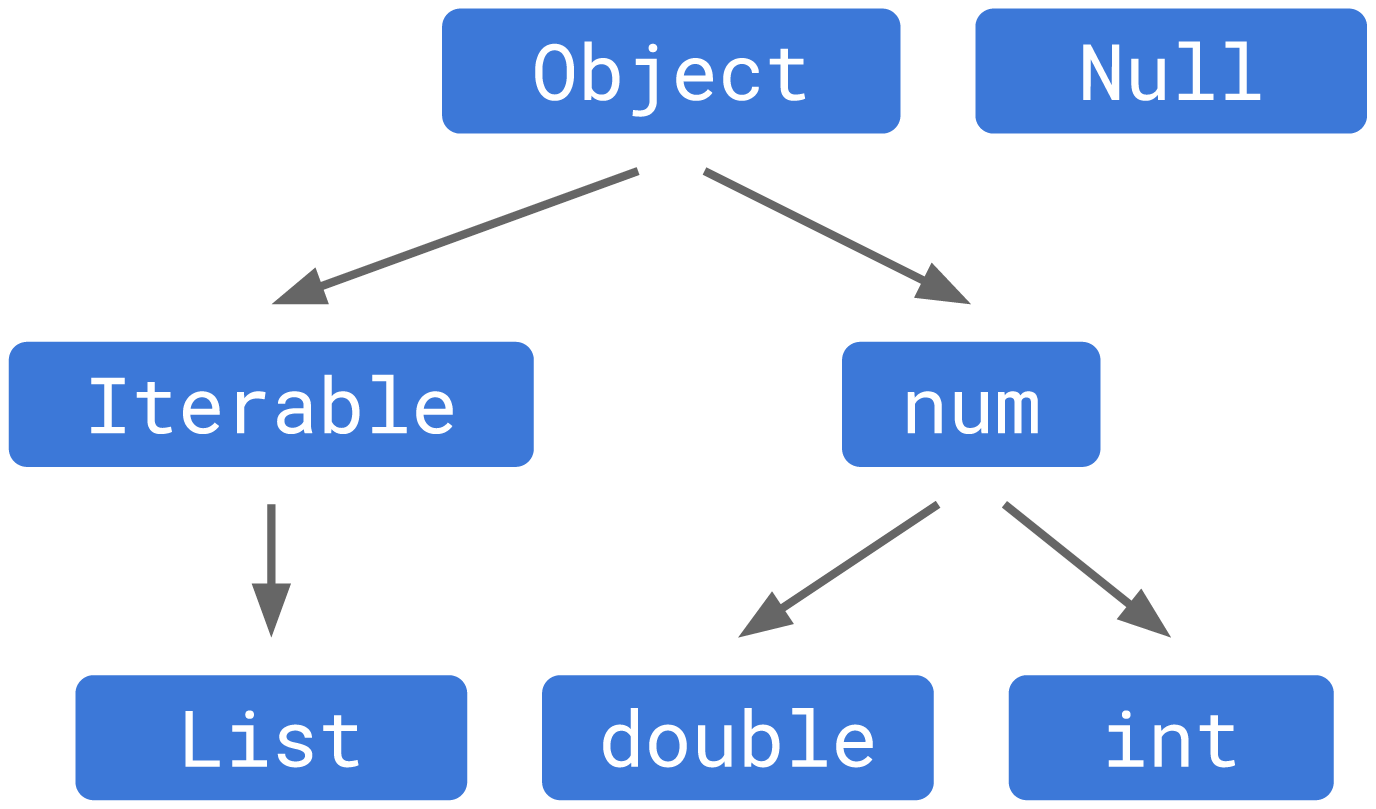
Null safety eliminates that problem at the root by changing the type hierarchy.
The `Null` type still exists, but it's no longer a subtype of all types.
Instead, the type hierarchy looks like this:
Since `Null` is no longer a subtype, no type except the special `Null` class
permits the value `null`. We've made all types *non-nullable by default*. If you
have a variable of type `String`, it will always contain *a string*. There,
we've fixed all null reference errors.
If we didn't think `null` was useful at all, we could stop here. But `null` is
useful, so we still need a way to handle it. Optional parameters are a good
illustrative case. Consider this null-safe Dart code:
```dart
// Using null safety:
void makeCoffee(String coffee, [String? dairy]) {
if (dairy != null) {
print('$coffee with $dairy');
} else {
print('Black $coffee');
}
}
```
Here, we want to allow the `dairy` parameter to accept any string, or the value
`null`, but nothing else. To express that, we give `dairy` a *nullable type* by
slapping `?` at the end of the underlying base type `String`. Under the hood,
this is essentially defining a [union][] of the underlying type and the `Null`
type. So `String?` would be a shorthand for `String|Null` if Dart had
full-featured union types.
[union]: https://en.wikipedia.org/wiki/Union_type
### Using nullable types
If you have an expression with a nullable type, what can you do with the result?
Since our principle is safe by default, the answer is not much. We can't let you
call methods of the underlying type on it because those might fail if the value
is `null`:
```dart
// Hypothetical unsound null safety:
void bad(String? maybeString) {
print(maybeString.length);
}
void main() {
bad(null);
}
```
This would crash if we let you run it. The only methods and properties we can
safely let you access are ones defined by both the underlying type and the
`Null` class. That's just `toString()`, `==`, and `hashCode`. So you can use
nullable types as map keys, store them in sets, compare them to other values,
and use them in string interpolation, but that's about it.
How do they interact with non-nullable types? It's always safe to pass a
*non*-nullable type to something expecting a nullable type. If a function
accepts `String?` then passing a `String` is allowed because it won't cause any
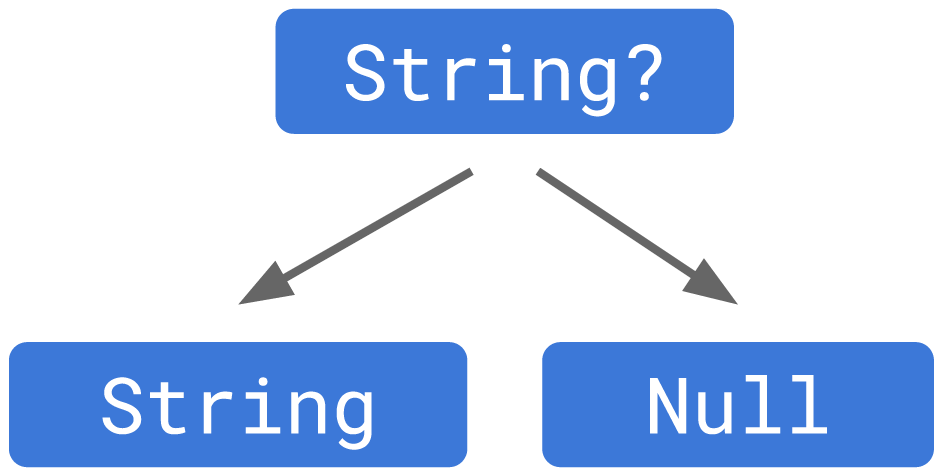
problems. We model this by making every nullable type a supertype of its
underlying type. You can also safely pass `null` to something expecting a nullable type, so
`Null` is also a subtype of every nullable type:
But going the other direction and passing a nullable type to something expecting
the underlying non-nullable type is unsafe. Code that expects a `String` may
call `String` methods on the value. If you pass a `String?` to it, `null` could
flow in and that could fail:
```dart
// Hypothetical unsound null safety:
void requireStringNotNull(String definitelyString) {
print(definitelyString.length);
}
void main() {
String? maybeString = null; // Or not!
requireStringNotNull(maybeString);
}
```
This program is not safe and we shouldn't allow it. However, Dart has always had
this thing called *implicit downcasts*. If you, for example, pass a value of
type `Object` to a function expecting a `String`, the type checker allows it:
```dart
// Without null safety:
void requireStringNotObject(String definitelyString) {
print(definitelyString.length);
}
void main() {
Object maybeString = 'it is';
requireStringNotObject(maybeString);
}
```
To maintain soundness, the compiler silently inserts an `as String` cast on the
argument to `requireStringNotObject()`. That cast could fail and throw an
exception at runtime, but at compile time, Dart says this is OK. Since
non-nullable types are modeled as subtypes of nullable types, implicit downcasts
would let you pass a `String?` to something expecting a `String`. Allowing that
would violate our goal of being safe by default. So with null safety we are
removing implicit downcasts entirely.
This makes the call to `requireStringNotNull()` produce a compile error, which
is what you want. But it also means *all* implicit downcasts become compile
errors, including the call to `requireStringNotObject()`. You'll have to add the
explicit downcast yourself:
```dart
// Using null safety:
void requireStringNotObject(String definitelyString) {
print(definitelyString.length);
}
void main() {
Object maybeString = 'it is';
requireStringNotObject(maybeString as String);
}
```
We think this is an overall good change. Our impression is that most users never
liked implicit downcasts. In particular, you may have been burned by this
before:
```dart
// Without null safety:
List filterEvens(List ints) {
return ints.where((n) => n.isEven);
}
```
Spot the bug? The `.where()` method is lazy, so it returns an `Iterable`, not a
`List`. This program compiles but then throws an exception at runtime when it
tries to cast that `Iterable` to the `List` type that `filterEvens` declares it
returns. With the removal of implicit downcasts, this becomes a compile error.
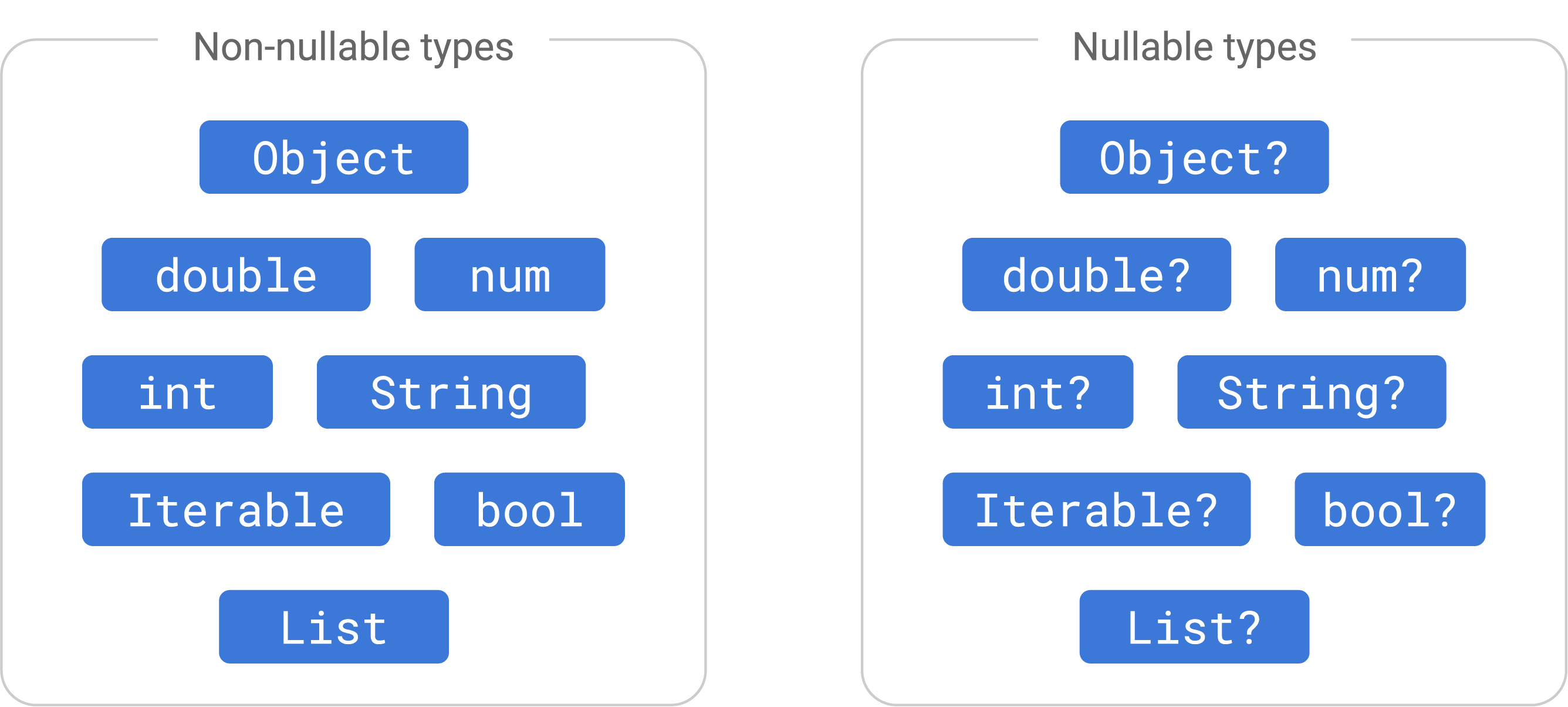
Where were we? Right, OK, so it's as if we've taken the universe of types in
your program and split them into two halves:
There is a region of non-nullable types. Those types let you access all of the
interesting methods, but can never ever contain `null`. And then there is a
parallel family of all of the corresponding nullable types. Those permit `null`,
but you can't do much with them. We let values flow from the non-nullable side
to the nullable side because doing so is safe, but not the other direction.
That seems like nullable types are basically useless. They have no methods and
you can't get away from them. Don't worry, we have a whole suite of features to
help you move values from the nullable half over to the other side that we will
get to soon.
### Top and bottom
This section is a little esoteric. You can mostly skip it, except for two
bullets at the very end, unless you're into type system stuff. Imagine all the
types in your program with edges between ones that are subtypes and supertypes
of each other. If you were to draw it, like the diagrams in this doc, it would
form a huge directed graph with supertypes like `Object` near the top and leaf
classes like your own types near the bottom.
If that directed graph comes to a point at the top where there is a single type
that is the supertype (directly or indirectly), that type is called the *top
type*. Likewise, if there is a weird type at that bottom that is a subtype of
every type, you have a *bottom type*. (In this case, your directed graph is a
[lattice.][lattice])
[lattice]: https://en.wikipedia.org/wiki/Lattice_(order)
It's convenient if your type system has a top and bottom type, because it means
that type-level operations like least upper bound (which type inference uses to
figure out the type of a conditional expression based on the types of its two
branches) can always produce a type. Before null safety, `Object` was Dart's top
type and `Null` was its bottom type.
Since `Object` is non-nullable now, it is no longer a top type. `Null` is not a
subtype of it. Dart has no *named* top type. If you need a top type, you want
`Object?`. Likewise, `Null` is no longer the bottom type. If it was, everything
would still be nullable. Instead, we've added a new bottom type named `Never`:
In practice, this means:
* If you want to indicate that you allow a value of any type, use `Object?`
instead of `Object`. In fact, it becomes pretty unusual to use `Object`
since that type means "could be any possible value except this one weirdly
prohibited value `null`".
* On the rare occasion that you need a bottom type, use
`Never` instead of `Null`.
This is particularly useful to indicate a function never returns
to [help reachability analysis](#never-for-unreachable-code).
If you don't know if you need a bottom type, you probably don't.
## Ensuring correctness
We divided the universe of types into nullable and non-nullable halves. In order
to maintain soundness and our principle that you can never get a null reference
error at runtime unless you ask for it, we need to guarantee that `null` never
appears in any type on the non-nullable side.
Getting rid of implicit downcasts and removing `Null` as a bottom type covers
all of the main places that types flow through a program across assignments and
from arguments into parameters on function calls. The main remaining places
where `null` can sneak in are when a variable first comes into being and when
you leave a function. So there are some additional compile errors:
### Invalid returns
If a function has a non-nullable return type, then every path through the
function must reach a `return` statement that returns a value. Before null
safety, Dart was pretty lax about missing returns. For example:
```dart
// Without null safety:
String missingReturn() {
// No return.
}
```
If you analyzed this, you got a gentle *hint* that *maybe* you forgot a return,
but if not, no big deal. That's because if execution reaches the end of a
function body then Dart implicitly returns `null`. Since every type is nullable,
*technically* this function is safe, even though it's probably not what you
want.
With sound non-nullable types, this program is flat out wrong and unsafe. Under
null safety, you get a compile error if a function with a non-nullable return
type doesn't reliably return a value. By "reliably", I mean that the language
analyzes all of the control flow paths through the function. As long as they all
return something, it is satisfied. The analysis is pretty smart, so even this
function is OK:
```dart
// Using null safety:
String alwaysReturns(int n) {
if (n == 0) {
return 'zero';
} else if (n < 0) {
throw ArgumentError('Negative values not allowed.');
} else {
if (n > 1000) {
return 'big';
} else {
return n.toString();
}
}
}
```
We'll dive more deeply into the new flow analysis in the next section.
### Uninitialized variables
When you declare a variable, if you don't give it an explicit initializer, Dart
default initializes the variable with `null`. That's convenient, but obviously
totally unsafe if the variable's type is non-nullable. So we have to tighten
things up for non-nullable variables:
* **Top level variable and static field declarations must have an
initializer.** Since these can be accessed and assigned from anywhere in the
program, it's impossible for the compiler to guarantee that the variable has
been given a value before it gets used. The only safe option is to require
the declaration itself to have an initializing expression that produces a
value of the right type:
```dart
// Using null safety:
int topLevel = 0;
class SomeClass {
static int staticField = 0;
}
```
* **Instance fields must either have an initializer at the declaration, use an
initializing formal, or be initialized in the constructor's initialization
list.** That's a lot of jargon. Here are the examples:
```dart
// Using null safety:
class SomeClass {
int atDeclaration = 0;
int initializingFormal;
int initializationList;
SomeClass(this.initializingFormal)
: initializationList = 0;
}
```
In other words, as long as the field has a value before you reach the
constructor body, you're good.
* Local variables are the most flexible case. A non-nullable local variable
*doesn't* need to have an initializer. This is perfectly fine:
```dart
// Using null safety:
int tracingFibonacci(int n) {
int result;
if (n < 2) {
result = n;
} else {
result = tracingFibonacci(n - 2) + tracingFibonacci(n - 1);
}
print(result);
return result;
}
```
The rule is only that **a local variable must be *definitely assigned*
before it is used.** We get to rely on the new flow analysis I alluded to
for this as well. As long as every path to a variable's use initializes it
first, the use is OK.
* **Optional parameters must have a default value.** If you don't pass an
argument for an optional positional or named parameter, then the language
fills it in with the default value. If you don't specify a default value,
the _default_ default value is `null`, and that doesn't fly if the parameter's
type is non-nullable.
So, if you want a parameter to be optional, you need to either make it
nullable or specify a valid non-`null` default value.
These restrictions sound onerous, but they aren't too bad in practice. They are
very similar to the existing restrictions around `final` variables and you've
likely been working with those for years without even really noticing. Also,
remember that these only apply to *non-nullable* variables. You can always make
the type nullable and then get the default initialization to `null`.
Even so, the rules do cause friction. Fortunately, we have a suite of new
language features to lubricate the most common patterns where these new
limitations slow you down. First, though, it's time to talk about flow analysis.
## Flow analysis
[Control flow analysis][] has been around in compilers for years. It's mostly
hidden from users and used during compiler optimization, but some newer
languages have started to use the same techniques for visible language features.
Dart already has a dash of flow analysis in the form of *type promotion*:
```dart
// With (or without) null safety:
bool isEmptyList(Object object) {
if (object is List) {
return object.isEmpty; // <-- OK!
} else {
return false;
}
}
```
[control flow analysis]: https://en.wikipedia.org/wiki/Control_flow_analysis
Note how on the marked line, we can call `isEmpty` on `object`. That method is
defined on `List`, not `Object`. This works because the type checker looks at
all of the `is` expressions and the control flow paths in the program. If the
body of some control flow construct only executes when a certain `is` expression
on a variable is true, then inside that body the variable's type is "promoted"
to the tested type.
In the example here, the then branch of the `if` statement only runs when
`object` actually contains a list. Therefore, Dart promotes `object` to type
`List` instead of its declared type `Object`. This is a handy feature, but it's
pretty limited. Prior to null safety, the following functionally identical
program did not work:
```dart
// Without null safety:
bool isEmptyList(Object object) {
if (object is! List) return false;
return object.isEmpty; // <-- Error!
}
```
Again, you can only reach the `.isEmpty` call when `object` contains a list, so
this program is dynamically correct. But the type promotion rules were not smart
enough to see that the `return` statement means the second statement can only be
reached when `object` is a list.
For null safety, we've taken this limited analysis and made it [much more
powerful in several ways.][flow analysis]
[flow analysis]: https://github.com/dart-lang/language/blob/main/resources/type-system/flow-analysis.md
### Reachability analysis
First off, we fixed the [long-standing complaint][18921] that type promotion
isn't smart about early returns and other unreachable code paths. When analyzing
a function, it now takes into account `return`, `break`, `throw`, and any other
way execution might terminate early in a function. Under null safety, this function:
[18921]: https://github.com/dart-lang/sdk/issues/18921
```dart
// Using null safety:
bool isEmptyList(Object object) {
if (object is! List) return false;
return object.isEmpty;
}
```
Is now perfectly valid. Since the `if` statement will exit the function when
`object` is *not* a `List`, Dart promotes `object` to be `List` on the second
statement. This is a really nice improvement that helps a lot of Dart code, even
stuff not related to nullability.
### Never for unreachable code
You can also *program* this reachability analysis. The new bottom type `Never`
has no values. (What kind of value is simultaneously a `String`, `bool`, and
`int`?) So what does it mean for an expression to have type `Never`? It means
that expression can never successfully finish evaluating. It must throw an
exception, abort, or otherwise ensure that the surrounding code expecting the
result of the expression never runs.
In fact, according to the language, the static type of a `throw` expression is
`Never`. The type `Never` is declared in the core libraries and you can use it
as a type annotation. Maybe you have a helper function to make it easier to
throw a certain kind of exception:
```dart
// Using null safety:
Never wrongType(String type, Object value) {
throw ArgumentError('Expected $type, but was ${value.runtimeType}.');
}
```
You might use it like so:
```dart
// Using null safety:
class Point {
final int x, y;
Point(this.x, this.y);
Point operator +(Object other) {
if (other is int) return Point(x + other, y + other);
if (other is! Point) wrongType('int | Point', other);
print('Adding two Point instances together: $this + $other');
return Point(x + other.x, y + other.y);
}
// toString, hashCode, and other implementations...
}
```
This program analyzes without error. Notice that the last line of the `+`
method accesses `.x` and `.y` on `other`. It has been promoted to `Point` even
though the function doesn't have any `return` or `throw`. The control flow
analysis knows that the declared type of `wrongType()` is `Never` which means
the then branch of the `if` statement *must* abort somehow. Since the final
statement can only be reached when `other` is a `Point`, Dart promotes it.
In other words, using `Never` in your own APIs lets you extend Dart's
reachability analysis.
### Definite assignment analysis
I mentioned this one briefly with local variables. Dart needs to ensure a
non-nullable local variable is always initialized before it is read. We use
*definite assignment analysis* to be as flexible about that as possible. The
language analyzes each function body and tracks the assignments to local
variables and parameters through all control flow paths. As long as the variable
is assigned on every path that reaches some use of a variable, the variable is
considered initialized. This lets you declare a variable with no initializer and
then initialize it afterwards using complex control flow, even when the variable
has a non-nullable type.
We also use definite assignment analysis to make *final* variables more
flexible. Before null safety, it can be difficult to use `final` for local
variables if you need to initialize them in any sort of interesting way:
```dart
// Using null safety:
int tracingFibonacci(int n) {
final int result;
if (n < 2) {
result = n;
} else {
result = tracingFibonacci(n - 2) + tracingFibonacci(n - 1);
}
print(result);
return result;
}
```
This would be an error since the `result` variable is `final` but has no
initializer. With the smarter flow analysis under null safety, this program is
fine. The analysis can tell that `result` is definitely initialized exactly once
on every control flow path, so the constraints for marking a variable `final`
are satisfied.
### Type promotion on null checks
The smarter flow analysis helps lots of Dart code, even code not related to
nullability. But it's not a coincidence that we're making these changes now. We
have partitioned types into nullable and non-nullable sets. If you have a value
of a nullable type, you can't really *do* anything useful with it. In cases
where the value *is* `null`, that restriction is good. It's preventing you from
crashing.
But if the value isn't `null`, it would be good to be able to move it over to
the non-nullable side so you can call methods on it. Flow analysis is one of the
primary ways to do this for local variables and parameters
(and private final fields, as of Dart 3.2). We've extended type
promotion to also look at `== null` and `!= null` expressions.
If you check a local variable with nullable type to see if it is not `null`,
Dart then promotes the variable to the underlying non-nullable type:
```dart
// Using null safety:
String makeCommand(String executable, [List? arguments]) {
var result = executable;
if (arguments != null) {
result += ' ' + arguments.join(' ');
}
return result;
}
```
Here, `arguments` has a nullable type. Normally, that prohibits you from calling
`.join()` on it. But because we have guarded that call in an `if` statement that
checks to ensure the value is not `null`, Dart promotes it from `List?`
to `List` and lets you call methods on it or pass it to functions that
expect non-nullable lists.
This sounds like a fairly minor thing, but this flow-based promotion on null
checks is what makes most existing Dart code work under null safety. Most Dart
code *is* dynamically correct and does avoid throwing null reference errors by
checking for `null` before calling methods. The new flow analysis on null checks
turns that *dynamic* correctness into provable *static* correctness.
It also, of course, works with the smarter analysis we do for reachability. The
above function can be written just as well as:
```dart
// Using null safety:
String makeCommand(String executable, [List? arguments]) {
var result = executable;
if (arguments == null) return result;
return result + ' ' + arguments.join(' ');
}
```
The language is also smarter about what kinds of expressions cause promotion. An
explicit `== null` or `!= null` of course works. But explicit casts using `as`,
or assignments, or the postfix `!` operator
(which we'll cover [later on](#not-null-assertion-operator)) also cause
promotion. The general goal is that if the code is dynamically correct and it's
reasonable to figure that out statically, the analysis should be clever enough
to do so.
Note that type promotion originally only worked on local variables,
and now also works on private final fields as of Dart 3.2.
For more information about working with non-local variables,
see [Working with nullable fields](#working-with-nullable-fields).
### Unnecessary code warnings
Having smarter reachability analysis and knowing where `null` can flow through
your program helps ensure that you *add* code to handle `null`. But we can also
use that same analysis to detect code that you *don't* need. Before null safety,
if you wrote something like:
```dart
// Using null safety:
String checkList(List
 The set of operations—getters, setters, methods, and
operators—allowed on some expressions are defined by its type. If the type
is `List`, you can call `.add()` or `[]` on it. If it's `int`, you can call `+`.
But the `null` value doesn't define any of those methods. Allowing `null` to
flow into an expression of some other type means any of those operations can
fail. This is really the crux of null reference errors—every failure comes
from trying to look up a method or property on `null` that it doesn't have.
### Non-nullable and nullable types
Null safety eliminates that problem at the root by changing the type hierarchy.
The `Null` type still exists, but it's no longer a subtype of all types.
Instead, the type hierarchy looks like this:
 Since `Null` is no longer a subtype, no type except the special `Null` class
permits the value `null`. We've made all types *non-nullable by default*. If you
have a variable of type `String`, it will always contain *a string*. There,
we've fixed all null reference errors.
If we didn't think `null` was useful at all, we could stop here. But `null` is
useful, so we still need a way to handle it. Optional parameters are a good
illustrative case. Consider this null-safe Dart code:
```dart
// Using null safety:
void makeCoffee(String coffee, [String? dairy]) {
if (dairy != null) {
print('$coffee with $dairy');
} else {
print('Black $coffee');
}
}
```
Here, we want to allow the `dairy` parameter to accept any string, or the value
`null`, but nothing else. To express that, we give `dairy` a *nullable type* by
slapping `?` at the end of the underlying base type `String`. Under the hood,
this is essentially defining a [union][] of the underlying type and the `Null`
type. So `String?` would be a shorthand for `String|Null` if Dart had
full-featured union types.
[union]: https://en.wikipedia.org/wiki/Union_type
### Using nullable types
If you have an expression with a nullable type, what can you do with the result?
Since our principle is safe by default, the answer is not much. We can't let you
call methods of the underlying type on it because those might fail if the value
is `null`:
```dart
// Hypothetical unsound null safety:
void bad(String? maybeString) {
print(maybeString.length);
}
void main() {
bad(null);
}
```
This would crash if we let you run it. The only methods and properties we can
safely let you access are ones defined by both the underlying type and the
`Null` class. That's just `toString()`, `==`, and `hashCode`. So you can use
nullable types as map keys, store them in sets, compare them to other values,
and use them in string interpolation, but that's about it.
How do they interact with non-nullable types? It's always safe to pass a
*non*-nullable type to something expecting a nullable type. If a function
accepts `String?` then passing a `String` is allowed because it won't cause any
problems. We model this by making every nullable type a supertype of its
underlying type. You can also safely pass `null` to something expecting a nullable type, so
`Null` is also a subtype of every nullable type:
 But going the other direction and passing a nullable type to something expecting
the underlying non-nullable type is unsafe. Code that expects a `String` may
call `String` methods on the value. If you pass a `String?` to it, `null` could
flow in and that could fail:
```dart
// Hypothetical unsound null safety:
void requireStringNotNull(String definitelyString) {
print(definitelyString.length);
}
void main() {
String? maybeString = null; // Or not!
requireStringNotNull(maybeString);
}
```
This program is not safe and we shouldn't allow it. However, Dart has always had
this thing called *implicit downcasts*. If you, for example, pass a value of
type `Object` to a function expecting a `String`, the type checker allows it:
```dart
// Without null safety:
void requireStringNotObject(String definitelyString) {
print(definitelyString.length);
}
void main() {
Object maybeString = 'it is';
requireStringNotObject(maybeString);
}
```
To maintain soundness, the compiler silently inserts an `as String` cast on the
argument to `requireStringNotObject()`. That cast could fail and throw an
exception at runtime, but at compile time, Dart says this is OK. Since
non-nullable types are modeled as subtypes of nullable types, implicit downcasts
would let you pass a `String?` to something expecting a `String`. Allowing that
would violate our goal of being safe by default. So with null safety we are
removing implicit downcasts entirely.
This makes the call to `requireStringNotNull()` produce a compile error, which
is what you want. But it also means *all* implicit downcasts become compile
errors, including the call to `requireStringNotObject()`. You'll have to add the
explicit downcast yourself:
```dart
// Using null safety:
void requireStringNotObject(String definitelyString) {
print(definitelyString.length);
}
void main() {
Object maybeString = 'it is';
requireStringNotObject(maybeString as String);
}
```
We think this is an overall good change. Our impression is that most users never
liked implicit downcasts. In particular, you may have been burned by this
before:
```dart
// Without null safety:
List
 There is a region of non-nullable types. Those types let you access all of the
interesting methods, but can never ever contain `null`. And then there is a
parallel family of all of the corresponding nullable types. Those permit `null`,
but you can't do much with them. We let values flow from the non-nullable side
to the nullable side because doing so is safe, but not the other direction.
That seems like nullable types are basically useless. They have no methods and
you can't get away from them. Don't worry, we have a whole suite of features to
help you move values from the nullable half over to the other side that we will
get to soon.
### Top and bottom
This section is a little esoteric. You can mostly skip it, except for two
bullets at the very end, unless you're into type system stuff. Imagine all the
types in your program with edges between ones that are subtypes and supertypes
of each other. If you were to draw it, like the diagrams in this doc, it would
form a huge directed graph with supertypes like `Object` near the top and leaf
classes like your own types near the bottom.
If that directed graph comes to a point at the top where there is a single type
that is the supertype (directly or indirectly), that type is called the *top
type*. Likewise, if there is a weird type at that bottom that is a subtype of
every type, you have a *bottom type*. (In this case, your directed graph is a
[lattice.][lattice])
[lattice]: https://en.wikipedia.org/wiki/Lattice_(order)
It's convenient if your type system has a top and bottom type, because it means
that type-level operations like least upper bound (which type inference uses to
figure out the type of a conditional expression based on the types of its two
branches) can always produce a type. Before null safety, `Object` was Dart's top
type and `Null` was its bottom type.
Since `Object` is non-nullable now, it is no longer a top type. `Null` is not a
subtype of it. Dart has no *named* top type. If you need a top type, you want
`Object?`. Likewise, `Null` is no longer the bottom type. If it was, everything
would still be nullable. Instead, we've added a new bottom type named `Never`:
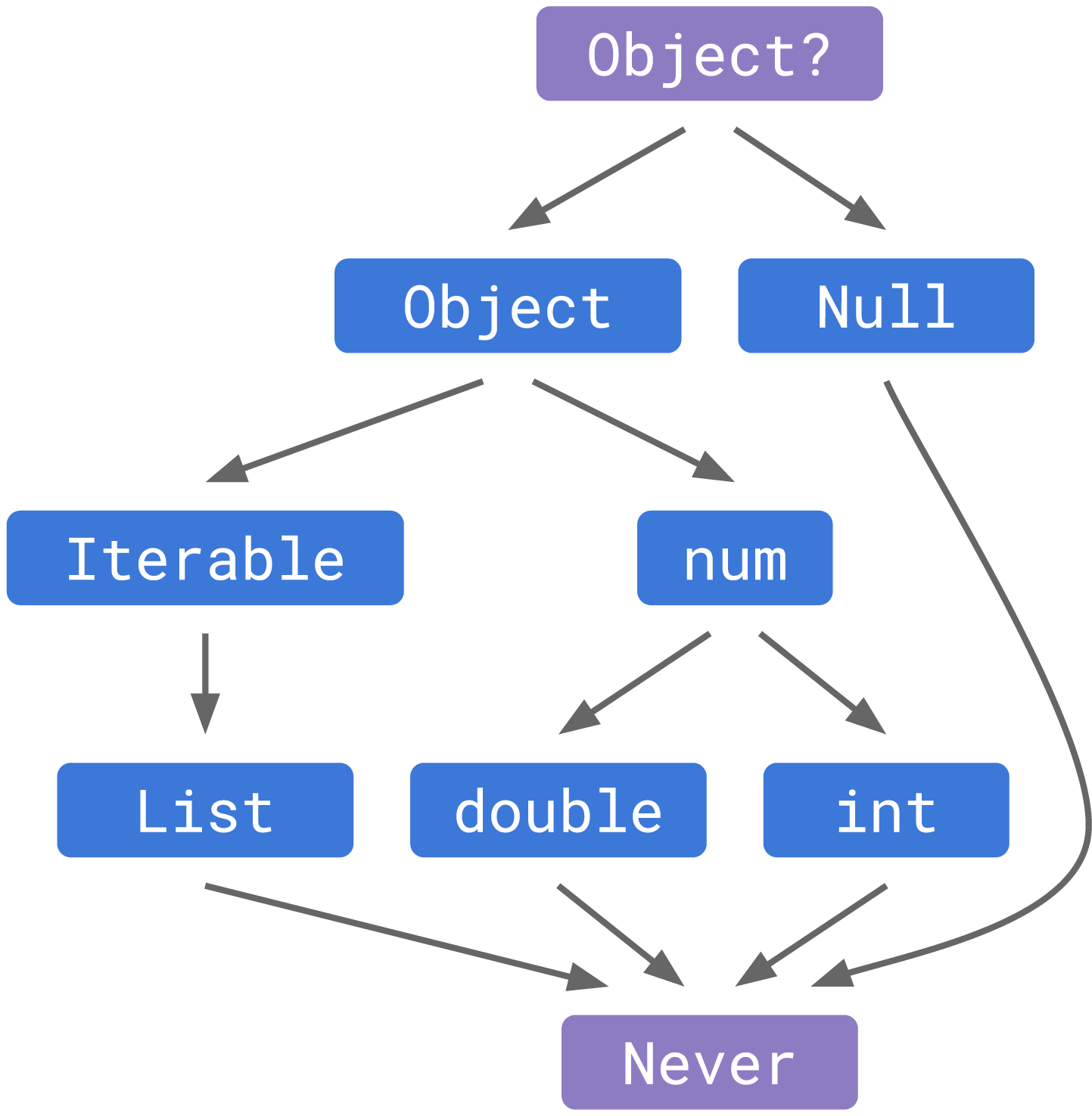 In practice, this means:
* If you want to indicate that you allow a value of any type, use `Object?`
instead of `Object`. In fact, it becomes pretty unusual to use `Object`
since that type means "could be any possible value except this one weirdly
prohibited value `null`".
* On the rare occasion that you need a bottom type, use
`Never` instead of `Null`.
This is particularly useful to indicate a function never returns
to [help reachability analysis](#never-for-unreachable-code).
If you don't know if you need a bottom type, you probably don't.
## Ensuring correctness
We divided the universe of types into nullable and non-nullable halves. In order
to maintain soundness and our principle that you can never get a null reference
error at runtime unless you ask for it, we need to guarantee that `null` never
appears in any type on the non-nullable side.
Getting rid of implicit downcasts and removing `Null` as a bottom type covers
all of the main places that types flow through a program across assignments and
from arguments into parameters on function calls. The main remaining places
where `null` can sneak in are when a variable first comes into being and when
you leave a function. So there are some additional compile errors:
### Invalid returns
If a function has a non-nullable return type, then every path through the
function must reach a `return` statement that returns a value. Before null
safety, Dart was pretty lax about missing returns. For example:
```dart
// Without null safety:
String missingReturn() {
// No return.
}
```
If you analyzed this, you got a gentle *hint* that *maybe* you forgot a return,
but if not, no big deal. That's because if execution reaches the end of a
function body then Dart implicitly returns `null`. Since every type is nullable,
*technically* this function is safe, even though it's probably not what you
want.
With sound non-nullable types, this program is flat out wrong and unsafe. Under
null safety, you get a compile error if a function with a non-nullable return
type doesn't reliably return a value. By "reliably", I mean that the language
analyzes all of the control flow paths through the function. As long as they all
return something, it is satisfied. The analysis is pretty smart, so even this
function is OK:
```dart
// Using null safety:
String alwaysReturns(int n) {
if (n == 0) {
return 'zero';
} else if (n < 0) {
throw ArgumentError('Negative values not allowed.');
} else {
if (n > 1000) {
return 'big';
} else {
return n.toString();
}
}
}
```
We'll dive more deeply into the new flow analysis in the next section.
### Uninitialized variables
When you declare a variable, if you don't give it an explicit initializer, Dart
default initializes the variable with `null`. That's convenient, but obviously
totally unsafe if the variable's type is non-nullable. So we have to tighten
things up for non-nullable variables:
* **Top level variable and static field declarations must have an
initializer.** Since these can be accessed and assigned from anywhere in the
program, it's impossible for the compiler to guarantee that the variable has
been given a value before it gets used. The only safe option is to require
the declaration itself to have an initializing expression that produces a
value of the right type:
```dart
// Using null safety:
int topLevel = 0;
class SomeClass {
static int staticField = 0;
}
```
* **Instance fields must either have an initializer at the declaration, use an
initializing formal, or be initialized in the constructor's initialization
list.** That's a lot of jargon. Here are the examples:
```dart
// Using null safety:
class SomeClass {
int atDeclaration = 0;
int initializingFormal;
int initializationList;
SomeClass(this.initializingFormal)
: initializationList = 0;
}
```
In other words, as long as the field has a value before you reach the
constructor body, you're good.
* Local variables are the most flexible case. A non-nullable local variable
*doesn't* need to have an initializer. This is perfectly fine:
```dart
// Using null safety:
int tracingFibonacci(int n) {
int result;
if (n < 2) {
result = n;
} else {
result = tracingFibonacci(n - 2) + tracingFibonacci(n - 1);
}
print(result);
return result;
}
```
The rule is only that **a local variable must be *definitely assigned*
before it is used.** We get to rely on the new flow analysis I alluded to
for this as well. As long as every path to a variable's use initializes it
first, the use is OK.
* **Optional parameters must have a default value.** If you don't pass an
argument for an optional positional or named parameter, then the language
fills it in with the default value. If you don't specify a default value,
the _default_ default value is `null`, and that doesn't fly if the parameter's
type is non-nullable.
So, if you want a parameter to be optional, you need to either make it
nullable or specify a valid non-`null` default value.
These restrictions sound onerous, but they aren't too bad in practice. They are
very similar to the existing restrictions around `final` variables and you've
likely been working with those for years without even really noticing. Also,
remember that these only apply to *non-nullable* variables. You can always make
the type nullable and then get the default initialization to `null`.
Even so, the rules do cause friction. Fortunately, we have a suite of new
language features to lubricate the most common patterns where these new
limitations slow you down. First, though, it's time to talk about flow analysis.
## Flow analysis
[Control flow analysis][] has been around in compilers for years. It's mostly
hidden from users and used during compiler optimization, but some newer
languages have started to use the same techniques for visible language features.
Dart already has a dash of flow analysis in the form of *type promotion*:
```dart
// With (or without) null safety:
bool isEmptyList(Object object) {
if (object is List) {
return object.isEmpty; // <-- OK!
} else {
return false;
}
}
```
[control flow analysis]: https://en.wikipedia.org/wiki/Control_flow_analysis
Note how on the marked line, we can call `isEmpty` on `object`. That method is
defined on `List`, not `Object`. This works because the type checker looks at
all of the `is` expressions and the control flow paths in the program. If the
body of some control flow construct only executes when a certain `is` expression
on a variable is true, then inside that body the variable's type is "promoted"
to the tested type.
In the example here, the then branch of the `if` statement only runs when
`object` actually contains a list. Therefore, Dart promotes `object` to type
`List` instead of its declared type `Object`. This is a handy feature, but it's
pretty limited. Prior to null safety, the following functionally identical
program did not work:
```dart
// Without null safety:
bool isEmptyList(Object object) {
if (object is! List) return false;
return object.isEmpty; // <-- Error!
}
```
Again, you can only reach the `.isEmpty` call when `object` contains a list, so
this program is dynamically correct. But the type promotion rules were not smart
enough to see that the `return` statement means the second statement can only be
reached when `object` is a list.
For null safety, we've taken this limited analysis and made it [much more
powerful in several ways.][flow analysis]
[flow analysis]: https://github.com/dart-lang/language/blob/main/resources/type-system/flow-analysis.md
### Reachability analysis
First off, we fixed the [long-standing complaint][18921] that type promotion
isn't smart about early returns and other unreachable code paths. When analyzing
a function, it now takes into account `return`, `break`, `throw`, and any other
way execution might terminate early in a function. Under null safety, this function:
[18921]: https://github.com/dart-lang/sdk/issues/18921
```dart
// Using null safety:
bool isEmptyList(Object object) {
if (object is! List) return false;
return object.isEmpty;
}
```
Is now perfectly valid. Since the `if` statement will exit the function when
`object` is *not* a `List`, Dart promotes `object` to be `List` on the second
statement. This is a really nice improvement that helps a lot of Dart code, even
stuff not related to nullability.
### Never for unreachable code
You can also *program* this reachability analysis. The new bottom type `Never`
has no values. (What kind of value is simultaneously a `String`, `bool`, and
`int`?) So what does it mean for an expression to have type `Never`? It means
that expression can never successfully finish evaluating. It must throw an
exception, abort, or otherwise ensure that the surrounding code expecting the
result of the expression never runs.
In fact, according to the language, the static type of a `throw` expression is
`Never`. The type `Never` is declared in the core libraries and you can use it
as a type annotation. Maybe you have a helper function to make it easier to
throw a certain kind of exception:
```dart
// Using null safety:
Never wrongType(String type, Object value) {
throw ArgumentError('Expected $type, but was ${value.runtimeType}.');
}
```
You might use it like so:
```dart
// Using null safety:
class Point {
final int x, y;
Point(this.x, this.y);
Point operator +(Object other) {
if (other is int) return Point(x + other, y + other);
if (other is! Point) wrongType('int | Point', other);
print('Adding two Point instances together: $this + $other');
return Point(x + other.x, y + other.y);
}
// toString, hashCode, and other implementations...
}
```
This program analyzes without error. Notice that the last line of the `+`
method accesses `.x` and `.y` on `other`. It has been promoted to `Point` even
though the function doesn't have any `return` or `throw`. The control flow
analysis knows that the declared type of `wrongType()` is `Never` which means
the then branch of the `if` statement *must* abort somehow. Since the final
statement can only be reached when `other` is a `Point`, Dart promotes it.
In other words, using `Never` in your own APIs lets you extend Dart's
reachability analysis.
### Definite assignment analysis
I mentioned this one briefly with local variables. Dart needs to ensure a
non-nullable local variable is always initialized before it is read. We use
*definite assignment analysis* to be as flexible about that as possible. The
language analyzes each function body and tracks the assignments to local
variables and parameters through all control flow paths. As long as the variable
is assigned on every path that reaches some use of a variable, the variable is
considered initialized. This lets you declare a variable with no initializer and
then initialize it afterwards using complex control flow, even when the variable
has a non-nullable type.
We also use definite assignment analysis to make *final* variables more
flexible. Before null safety, it can be difficult to use `final` for local
variables if you need to initialize them in any sort of interesting way:
```dart
// Using null safety:
int tracingFibonacci(int n) {
final int result;
if (n < 2) {
result = n;
} else {
result = tracingFibonacci(n - 2) + tracingFibonacci(n - 1);
}
print(result);
return result;
}
```
This would be an error since the `result` variable is `final` but has no
initializer. With the smarter flow analysis under null safety, this program is
fine. The analysis can tell that `result` is definitely initialized exactly once
on every control flow path, so the constraints for marking a variable `final`
are satisfied.
### Type promotion on null checks
The smarter flow analysis helps lots of Dart code, even code not related to
nullability. But it's not a coincidence that we're making these changes now. We
have partitioned types into nullable and non-nullable sets. If you have a value
of a nullable type, you can't really *do* anything useful with it. In cases
where the value *is* `null`, that restriction is good. It's preventing you from
crashing.
But if the value isn't `null`, it would be good to be able to move it over to
the non-nullable side so you can call methods on it. Flow analysis is one of the
primary ways to do this for local variables and parameters
(and private final fields, as of Dart 3.2). We've extended type
promotion to also look at `== null` and `!= null` expressions.
If you check a local variable with nullable type to see if it is not `null`,
Dart then promotes the variable to the underlying non-nullable type:
```dart
// Using null safety:
String makeCommand(String executable, [List